The Complete Guide to Building a Doula Client Intake Form That Protects You and Serves Your Families.
A doula client intake form is more than paperwork. In the birth space, it is the first act of care. The questions you ask — and how you ask them — signal to a prospective client whether you are a transactional service provider or a genuine birth keeper who sees the full human being in front of you. And from a business perspective, a thorough, legally sound intake questionnaire is the single most powerful tool you have for protecting your scope of practice, your liability insurance, and your time.
This guide breaks down everything you need to know about designing, sending, and storing a high-quality doula intake form in 2025 — whether you are a newly certified DONA birth doula, a CAPPA-trained postpartum specialist, or an experienced full-spectrum doula onboarding your tenth client this year.
Why Your Doula Intake Form Is a Business Asset, Not Just a Formality
Most new doulas treat their intake form as a logistical checkbox — a PDF they email over once the contract is signed. Experienced doulas treat it as a strategic business document. Here is the difference: a generic contact form collects a name, a due date, and a phone number. A professional doula client intake questionnaire collects the complete physiological, psychological, and relational context you need to show up as the best possible support on the most important day of a family's life.
Consider what happens without a thorough intake. You arrive at a hospital birth and discover, mid-labor, that your client has a history of VBAC (Vaginal Birth After Cesarean) that the partner forgot to mention. Or you learn during active pushing that your client has a severe needle phobia and the anesthesiologist is about to place an IV. Or you discover the morning of the birth that the client's mother — not the partner — is the primary emotional support person and is not on the hospital's approved visitors list. Every one of these scenarios is preventable with a well-designed doula intake form sent and reviewed before the on-call window opens.
"Your intake form is your first prenatal visit. The questions you ask before you ever step into a birth room determine the quality of support you can provide once you get there."
— Maternal Support Co. Doula Business Framework
Beyond clinical preparation, a formal intake system signals professionalism. When a prospective client receives a beautifully designed, thoughtfully worded 5-page intake questionnaire — instead of a text message asking "so tell me about your birth!" — they understand immediately that they have hired an experienced practitioner who takes this work seriously. That perception gap is the difference between families who refer you enthusiastically and families who ghost you after the birth.
When to Send a Doula Intake Form: The Right Timing Strategy
One of the most common mistakes new doulas make is sending the full intake questionnaire during — or before — the initial discovery call. This is a well-intentioned but counterproductive move. A 5-page medical and psychological intake form sent to a prospective client who has not yet confirmed they want to hire you creates unnecessary friction and can feel invasive or clinical before any rapport is built.
The gold-standard timing framework works in four sequential stages:
Discovery Call (Pre-Contract)
Use a 4–6 question verbal script or a single-page pre-screening form. Confirm EDD, birth location, budget alignment, and mutual availability only. Save the deep questions for later.
Contract Signing + Retainer
Once the family has signed your service agreement and paid the retainer, send a welcome email confirming their on-call window and attaching the full intake form link.
Intake Review (Pre-Prenatal Visit #1)
Give the client 5–7 days to complete the form in their own home, then review it thoroughly before your first prenatal visit. Flag items to discuss in person.
Pre-Birth Refresh (Week 36–37)
Send a brief 3–5 question update form asking if anything has changed: new hospital policies, updated GBS results, change in birth preferences, or new anxieties that emerged in the third trimester.
This four-stage approach respects boundaries, protects your non-billable time during the courtship phase, and ensures you always have current, accurate information before the birth window opens.
The 17 Essential Questions Every Doula Client Intake Form Must Include
Below is the definitive list of questions that should appear somewhere in your doula intake form or discovery questionnaire sequence — adapted from the six-pillar framework embedded in our Birth Doula Client Packet. Each question is annotated with its clinical and business rationale.
Category 1 — Care Team & Facility Logistics
-
1
"Where do you plan to give birth, and who is your primary healthcare provider (OB-GYN or midwife)?"
Allows you to research hospital visitor policies, confirm parking logistics, and assess whether the provider is known to be supportive of doulas in the birth room. -
2
"What is your estimated due date (EDD) and what is your on-call window expectation?"
Establishes your on-call commitment, clarifies overlap with other clients, and helps you schedule backup doula arrangements if needed. -
3
"Who are your emergency contacts, and who is your primary support person at the birth?"
Vital for triage situations where a client is unable to communicate. Also clarifies the relational dynamics you will be navigating in the birth room.
Category 2 — Obstetric & Medical History
-
4
"Please share your complete pregnancy and birth history (gravida/para, any miscarriages, stillbirths, or prior c-sections)."
Informs precipitous labor risk, VBAC/TOLAC eligibility discussions, and emotional vulnerability around anniversaries or losses. -
5
"Do you have any diagnosed conditions relevant to this pregnancy (GBS status, placenta previa, gestational diabetes, preeclampsia history)?"
These conditions directly affect labor positioning options, movement guidance, and interventions that may be hospital-mandated. -
6
"Do you have any spinal, pelvic, or musculoskeletal injuries or chronic pain conditions?"
Determines which rebozo techniques, counter-pressure methods, or Spinning Babies positions are safe and which must be avoided entirely. -
7
"What medical interventions are you open to, hesitant about, or firmly opposed to (epidural, Pitocin, continuous fetal monitoring, membrane sweep)?"
This single question forms the baseline for your shared birth plan and prevents you from inadvertently advocating against your client's own wishes in the birth room.
Category 3 — Trauma & Emotional Safety
-
8
"Have you experienced any previous birth trauma, medical trauma, or difficult prenatal experiences you feel comfortable sharing?"
Framing this as optional and non-diagnostic opens the door without forcing disclosure. Many clients share profound traumas here that completely reshape your support approach. -
9
"Are there specific types of physical touch, body areas, or clinical procedures that cause you anxiety or that you would like your care team to approach gently?"
This is one of the most important trauma-informed questions on any doula intake form. It prevents inadvertent re-traumatization during cervical checks, IV placement, and position changes. -
10
"How do you typically respond when you feel overwhelmed, in pain, or stressed — do you go inward, need verbal encouragement, or prefer physical presence?"
Coping style is highly individual. This prevents you from over-talking a client who needs silence, or standing silently beside a client who desperately needs affirmation. -
11
"What is a non-verbal signal, gesture, or safe phrase we can agree on that means 'I need a moment alone' or 'please clear the room'?"
Establishes a discreet communication protocol that respects the birthing person's autonomy without requiring them to verbally advocate for themselves during transition.
Category 4 — Partner & Family Dynamics
-
12
"How does your partner or primary support person envision their role at the birth (hands-on, emotional anchor, or background observer)?"
Prevents you from accidentally displacing a partner who wants to be actively involved, or placing unrealistic emotional demands on a partner who is themselves frightened or inexperienced. -
13
"Are there any family members, visitors, or specific people you do or do not want present at the birth?"
Family boundary conflicts are a significant source of stress during labor. Having a documented, pre-agreed plan protects you from being caught between a client and their mother-in-law.
Category 5 — Postpartum & Infant Feeding
-
14
"What are your infant feeding goals — breastfeeding, chestfeeding, pumping, formula, combination, or undecided — and do you want IBCLC support in your plan?"
Allows you to pre-arrange IBCLC referrals, prepare a feeding support resource list, and avoid making assumptions that any particular method is the goal. -
15
"Do you have a personal or family history of postpartum depression, anxiety, OCD, psychosis, or other perinatal mood and anxiety disorders (PMADs)?"
Establishes a PMAD baseline so you can provide appropriately heightened emotional check-ins during postpartum visits and refer to a perinatal mental health therapist proactively.
Category 6 — Non-Clinical Scope & Legal Consent
-
16
"I acknowledge that my doula's role is non-clinical: she does not perform vaginal exams, check blood pressure, read fetal heart tracings, or provide medical advice."
A signed scope acknowledgment is non-negotiable for protecting your certification, your insurance, and your business in the event of a birth outcome dispute. -
17
"Do you give consent for birth photography, the use of anonymized details in educational materials, or social media posts? (Please specify.)"
Photo and content release must be obtained in writing before the birth, not asked for in the exhausted haze of the postpartum period when consent may not be fully informed.
How to Write Trauma-Informed Questions on a Doula Intake Form
The language you use on your doula client intake form is as important as the questions themselves. Trauma-informed care principles teach us that the way we ask a question either opens a door or shuts one. A clinical, interrogative question frame — "Do you have a history of sexual assault?" — can re-traumatize a client before your relationship has even begun. A consent-centered, open-ended frame creates psychological safety while still gathering the information you need.
❌ Avoid — Clinical / Diagnostic
- "Do you have PTSD?"
- "History of sexual abuse — yes/no?"
- "Rate your pain tolerance on a scale of 1–10."
- "Are you prepared for an unmedicated birth?"
✓ Use — Consent-Centered / Open
- "Are there past experiences you'd like your support team to be aware of?"
- "Are there touch cues or sensitivities your care team should approach gently?"
- "How do you typically respond to intense physical sensations?"
- "What does ideal birth support look like to you?"
Always include a note at the top of your trauma section: "These questions are entirely optional. You may skip any question and discuss it verbally at our prenatal visit instead. Your comfort with this process matters." This short statement dramatically increases the rate of honest disclosure because clients feel in control of the process.
Postpartum Doula Intake Form: Key Differences From a Birth Doula Intake
If you offer postpartum doula services, your intake form needs a fundamentally different focus. Where a birth doula intake centers on the event — the labor, the birth plan, the delivery room — a postpartum doula intake must center on the recovery environment: the home, the household structure, the infant feeding challenges, and the mental health baseline that determines whether the first six weeks will be empowering or overwhelming.
Key questions to add to a postpartum doula intake form that are typically absent from birth doula forms include:
- What does a typical household day look like and who else lives in the home (siblings, parents, pets)?
- What tasks are most important to you during a doula shift — baby care so you can sleep, meal prep, light housekeeping, or emotional companionship?
- Do you have a support network or are you largely isolated during the day?
- What does your home feeding setup look like — nursing station, pump equipment, bottle prep area?
- Are there cultural, religious, or traditional postpartum practices you observe (sitting the month, zuo yuezi, jappa, etc.) that shape your recovery expectations?
- What is your communication preference for shift check-ins and follow-up — text, email, voice note?
The postpartum intake form is also where you establish explicit task boundaries so that your client never wonders whether asking you to fold laundry or prep a meal is "too much." Your scope should be stated clearly and positively: "As your postpartum doula, I am here to support your recovery in whatever way is most helpful — whether that is newborn care while you sleep, meal preparation, light tidying, or simply talking through the challenges of new parenthood. Please tell me what matters most to you."
Digital vs. Paper Doula Intake Forms: Pros, Cons & Best Practices
Most working doulas today use one of three formats: a printable PDF they email and ask clients to scan back, an editable Canva template they share as a Canva link, or an interactive web-based form the client fills out directly on their phone. Each has legitimate use cases, but the format you choose affects your professional image, your client's completion rate, and your data storage obligations.
| Format | Pros | Cons |
|---|---|---|
| Printable PDF | Familiar, offline-friendly, can be hand-signed | Requires printing/scanning, low completion rates, poor for mobile |
| Editable Canva Link | Branded, visually polished, Canva-shareable PDF export | Requires client Canva account, collaborative link can be confusing |
| Phone-Fillable Web Form | Highest completion rates, mobile-native, instant PDF export, no app download required | Requires a reliable link, less recognizable as a "form" to older clients |
| Google Forms / Typeform | Free, easy to build, auto-collected responses | Generic appearance, no branding, limited legal consent format |
Our recommendation for most birth doulas in 2025: use a branded Canva PDF template that doubles as a visual document (for your records) plus a phone-fillable interactive version for clients who prefer not to print. This combination gives you professional documentation and maximum client convenience without a monthly SaaS subscription.
HIPAA, Privacy Law & Safe Storage of Doula Client Intake Forms
One of the most common questions doulas ask is: "Am I required to follow HIPAA regulations for my client intake forms?" The short answer: most independent, cash-pay doulas are not classified as HIPAA "covered entities" because they do not electronically transmit standardized health insurance claims. However, this legal technicality does not eliminate your ethical obligation to protect sensitive perinatal health data with the same rigor that you would expect from any healthcare provider.
Best-practice storage recommendations for doula intake forms:
- Cloud storage with password protection — Google Drive with restricted sharing or Dropbox Business with two-factor authentication.
- Separate client folders with file naming conventions — "LastName_FirstName_IntakeForm_[Year].pdf" prevents folder confusion when you have 20+ active or past clients.
- Retention policy — Most doula organizations recommend retaining client records for a minimum of 7 years post-service, even for cash-pay clients, in case of a future dispute.
- Never use personal text threads or public email attachments — Standard Gmail or iMessage is unencrypted and inappropriate for sensitive medical and psychological disclosures.
- Include a storage consent clause in your intake form — Clients should acknowledge that their intake data will be stored digitally and retained for a specified period.
If you are building a doula practice website, integrating an encrypted intake form directly into your site — rather than emailing PDF attachments — is the cleanest and most professionally positioned solution. Our done-for-you doula website packages include embedded intake forms with client privacy disclosures and encrypted form submission as standard features.
Ready-to-Use Doula Intake Form Templates: Free & Premium Options
Building your doula client intake form from scratch is a multi-hour project when done properly. You need to research appropriate question sets, write trauma-informed phrasing, format a legally structured consent section, and design something that looks professional enough to send to a family who is trusting you with one of the most significant events of their lives. Most doulas underestimate how long this takes — and how often the DIY version ends up looking like a rushed Google Form at odds with the beautiful brand they worked hard to build.
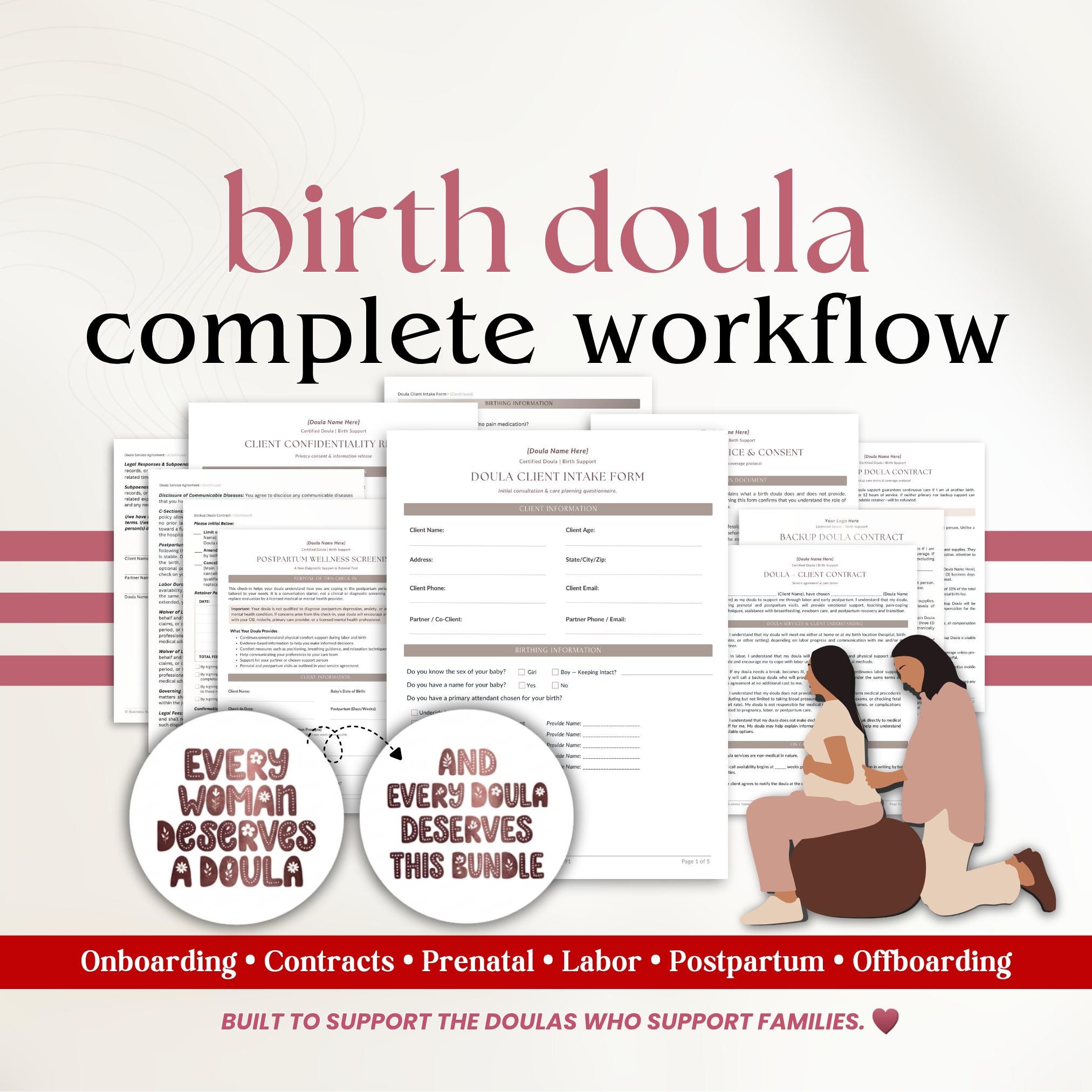
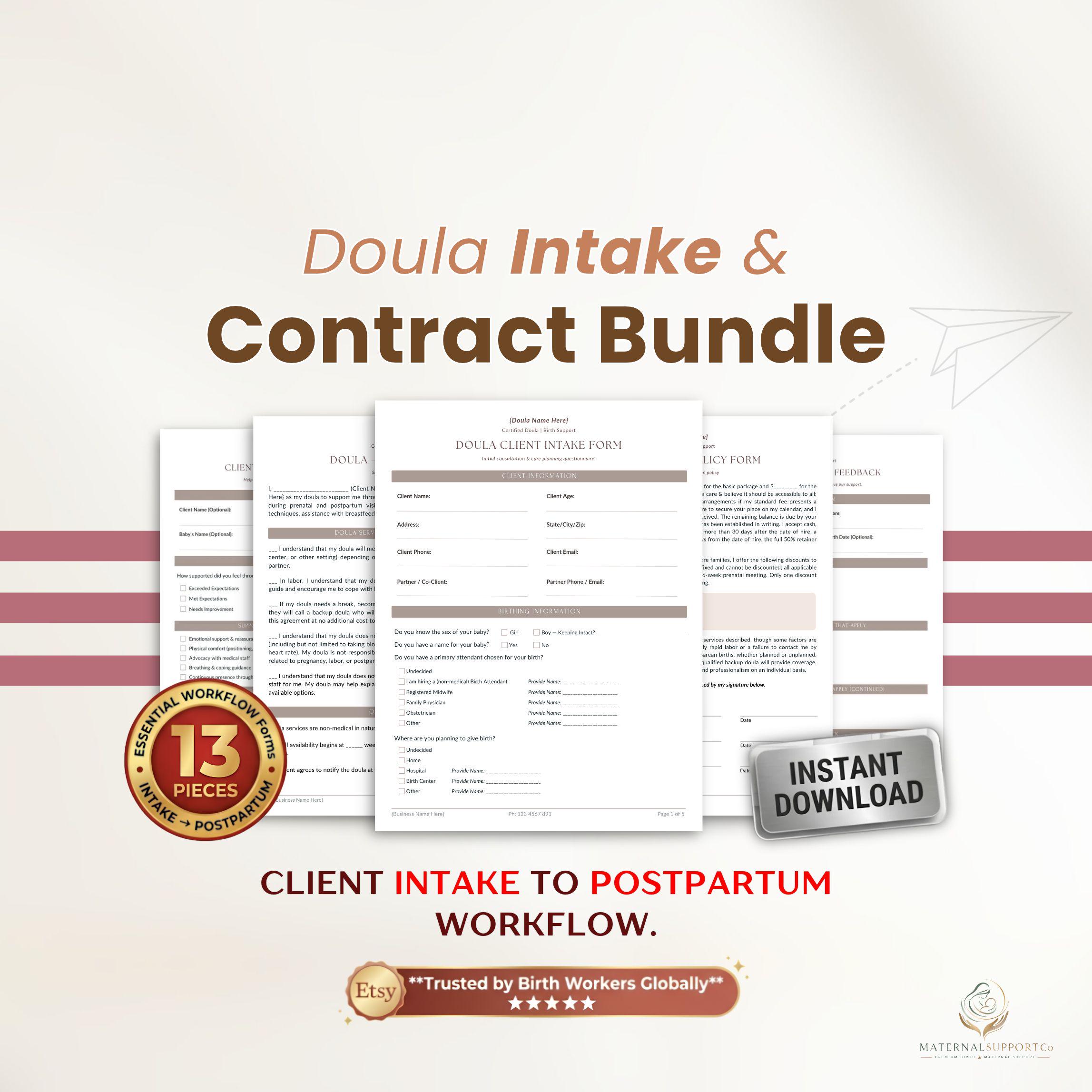
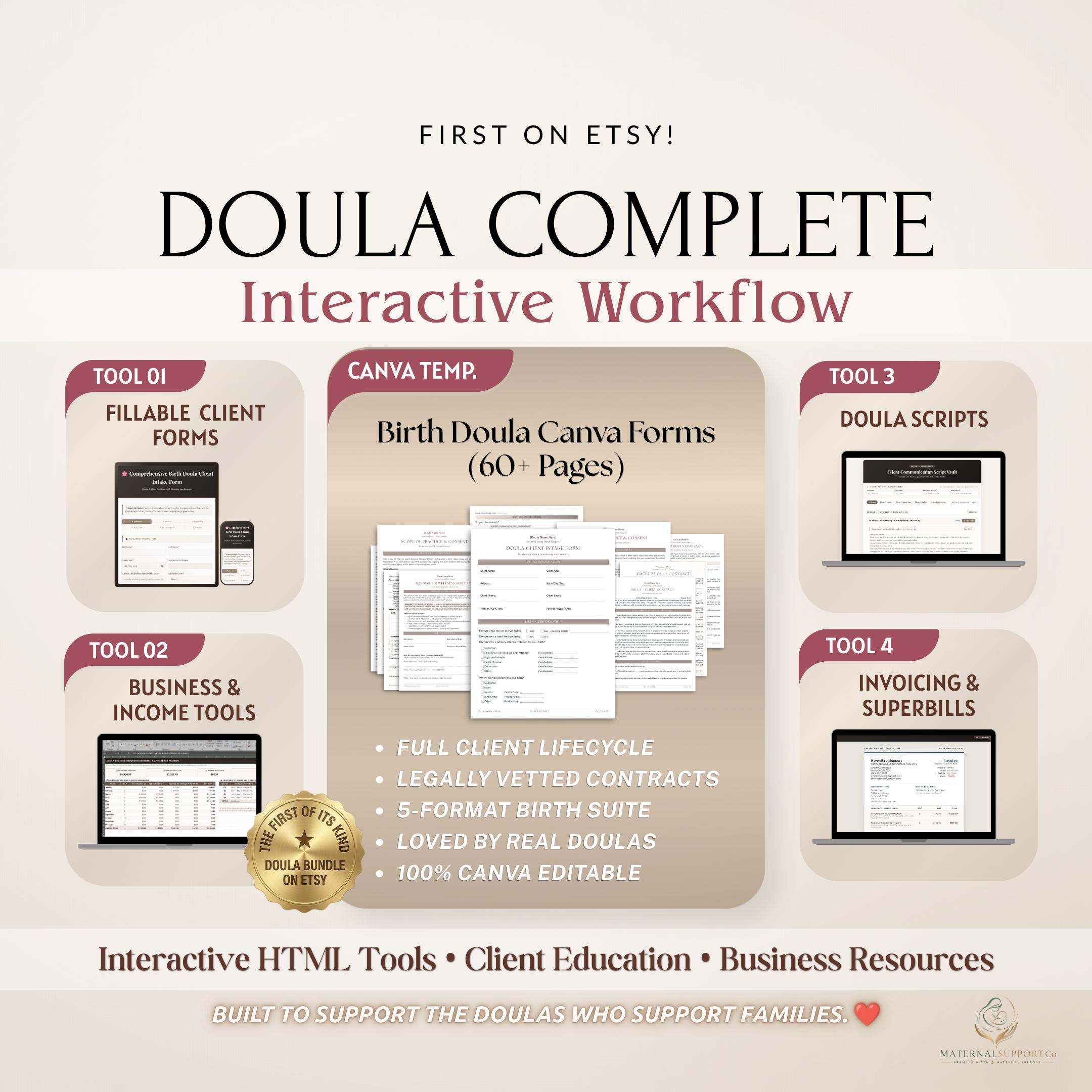
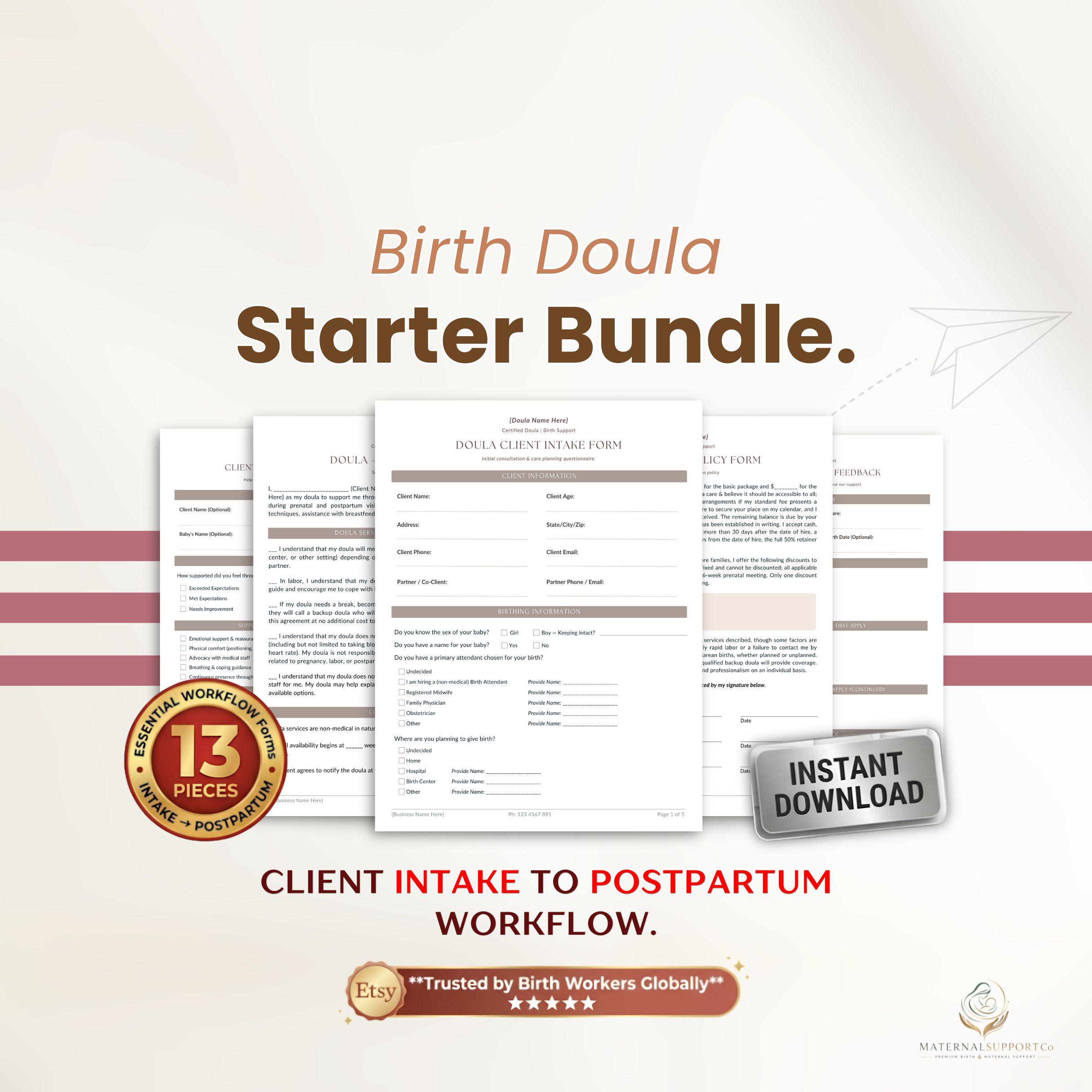
Here is a breakdown of the options available at Maternal Support Co., from a free first-contact checklist to a complete 90-page client management system:
🎁 Free: First-Contact Intake Checklist (17 Questions)
An interactive, browser-fillable 1-page checklist covering the most essential pre-booking discovery questions. Opens on any smartphone.
For doulas ready to run a fully professional onboarding system, the Birth Doula Client Packet ($37) includes 90+ pages across 30+ Canva templates: a 5-page obstetric intake questionnaire, discovery call scripts, prenatal visit guides, a labor support log, birth preference sheets, a doula service contract, and a bonus mileage and expense tracker spreadsheet — everything you need to run a complete client lifecycle from initial inquiry through postpartum discharge, all editable in free Canva.
Trusted by Birth & Postpartum Doulas
Rated 4.9/5 ★ — DONA, CAPPA & ProDoula certified birth specialists. Instant download. 100% editable in free Canva.